What is Varve?
A local-first design suite for vector, layout, typography, motion, and print — one application, no account, no subscription. It runs natively on Linux, macOS, and Windows on the same Rust engine. Documents are saved as local files on your machine; there is no hosted web app yet.
Connected creative workflows
Most creative work spans multiple disciplines. A poster needs vector shapes, typography, and print-ready export. A social media campaign needs layout, animation, and multiple output formats. A product design needs components, prototyping, and developer handoff.
Varve is designed to keep this work in one place. Instead of switching between separate applications and rebuilding your context each time, you move between tasks within the same document, the same layer system, and the same interface.
Watch a workflow
A real editing pass recorded from the application: select a layer, reshape a Bézier path in node-edit mode, then open the export dialog. Like every image on this site, it is captured by a deterministic pipeline from a seeded demo document — never hand-edited.
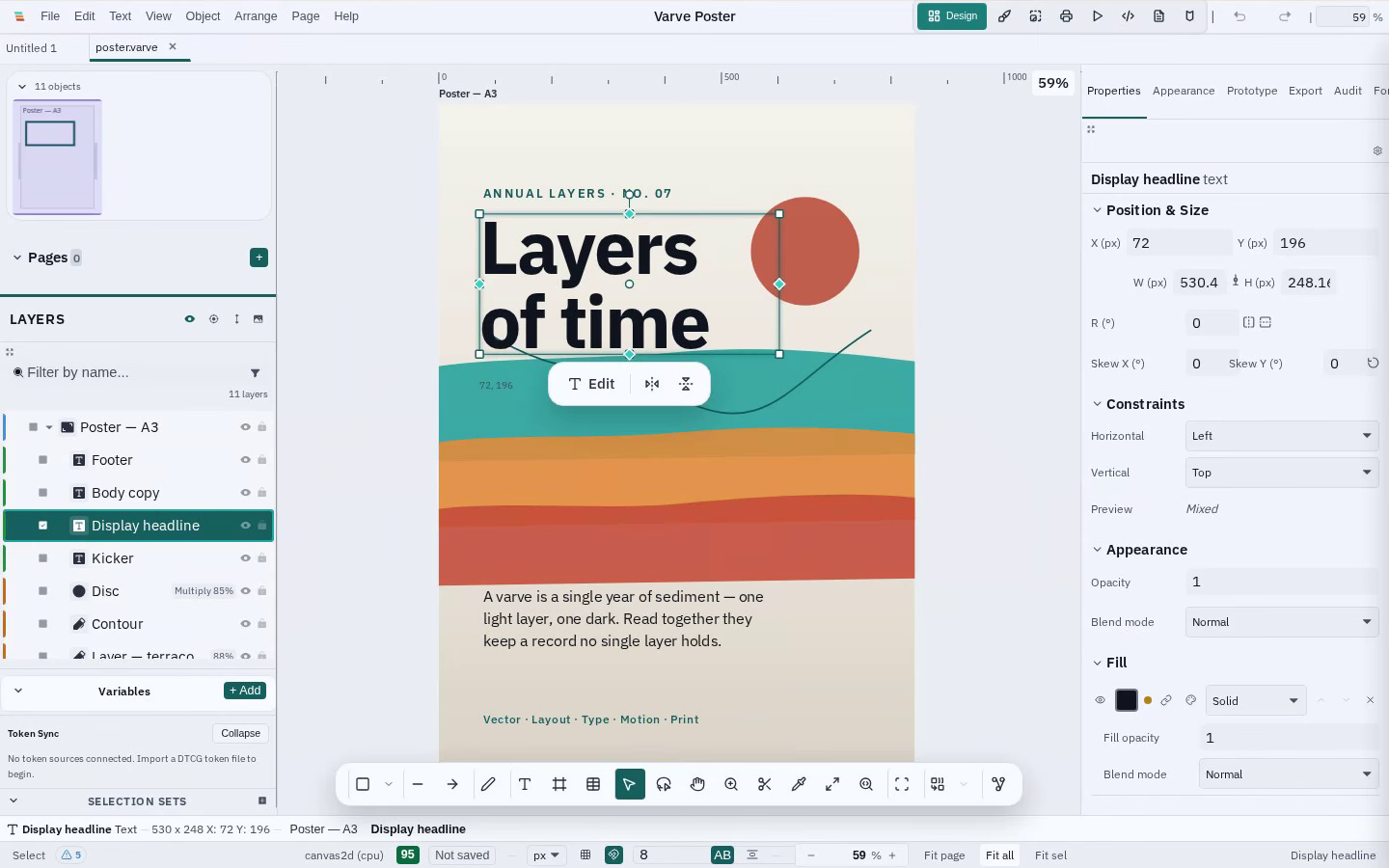
Local-first, your files, your machine
Varve stores design data locally. No account or mandatory cloud sync is required, and core editing works offline. Optional model downloads, online font/icon search, user-configured providers, update checks, and aggregate measurements are separate network features; consented measurements do not include design content. You own your files, you control where they live, and the desktop application uses a native Rust engine. The same engine is compiled to WASM for the web target (a hosted web app is not available yet).
Cross-platform native performance
Varve runs natively on Linux (CachyOS, Arch, Ubuntu, Fedora — x86_64 and ARM64), macOS (Apple Silicon), and Windows (x86_64 and ARM64). The rendering architecture separates scene computation from display, using an intermediate representation that replays efficiently to the canvas. The same codebase powers both the native desktop and WASM web builds.
Source-available, shaped by its users
Varve is licensed under FSL-1.1-MIT — free to use, with source code available on GitHub. Development is transparent: architecture decisions, known limitations, and progress are documented publicly. Community input influences priorities. No VC pressure and no feature-checklist deadlines — features are built when they work, not when they sound good in marketing copy.
Who is Varve for?
Linux users
Creators on Linux who need a native design application with first-class platform support, CMYK print, and a Rust rendering engine.
Multi-disciplinary creators
Designers who switch between vector, layout, motion, and print work and want one document model instead of separate apps.
Privacy-conscious creators
Freelancers and independents who want professional tools without subscription costs, cloud dependencies, or mandatory accounts.
Early adopters
People who want to test emerging workflows, report problems, and influence the direction of a developing creative tool.
Who Varve is not for (yet)
Because Varve is in beta, it is not yet the right choice for every situation:
- Critical production deadlines: expect bugs, incomplete tools, and workflow changes. Keep backups and test before relying on it for paid work.
- Teams needing real-time collaboration: collaboration is not implemented — this is a single-user tool today.
- Complex-script text: the engine has a canonical UAX #9 + paragraph layout pipeline (itemization, line breaking, visual run order, caret geometry), but live Canvas2D shaping and export parity for Arabic, Hebrew, Devanagari, Thai, and similar scripts remains in development.
- Intel Macs: macOS builds target Apple Silicon only. The on-device AI depends on the ONNX Runtime, whose upstream discontinued Intel macOS binaries, and Apple has ended new Intel macOS support.
Coming from another design tool?
See how Varve compares to Figma, Adobe Illustrator, Affinity, Sketch, Inkscape, and Penpot — what's genuinely different, and where Varve still falls short today.
Beta status
Varve is in public beta. Core features are functional and tested, but you may encounter bugs, incomplete tools, or changes to workflows and file formats as development continues. We recommend keeping backups of important work and not relying on Varve as the sole tool for critical production projects at this stage.
The value of participating now: test emerging workflows, report problems that matter to you, and help shape where Varve goes next. See the known issues and release notes for current limitations.
Get started
Try Varve beta.
Free and source-available under FSL-1.1-MIT. Expect rough edges — it is an early release.