Canvas & Rendering
86fps IR-replay rendering with infinite canvas, precision tools, and native Rust performance.
What It Is
Varve's canvas system uses IR-replay architecture: the Rust engine computes the scene and emits a compact intermediate representation (~42 KB/frame for 600 shapes), which the webview replays to canvas2D. This separation enables 86fps rendering on Wayland compared to 8.5fps with pixel-pushing approaches.
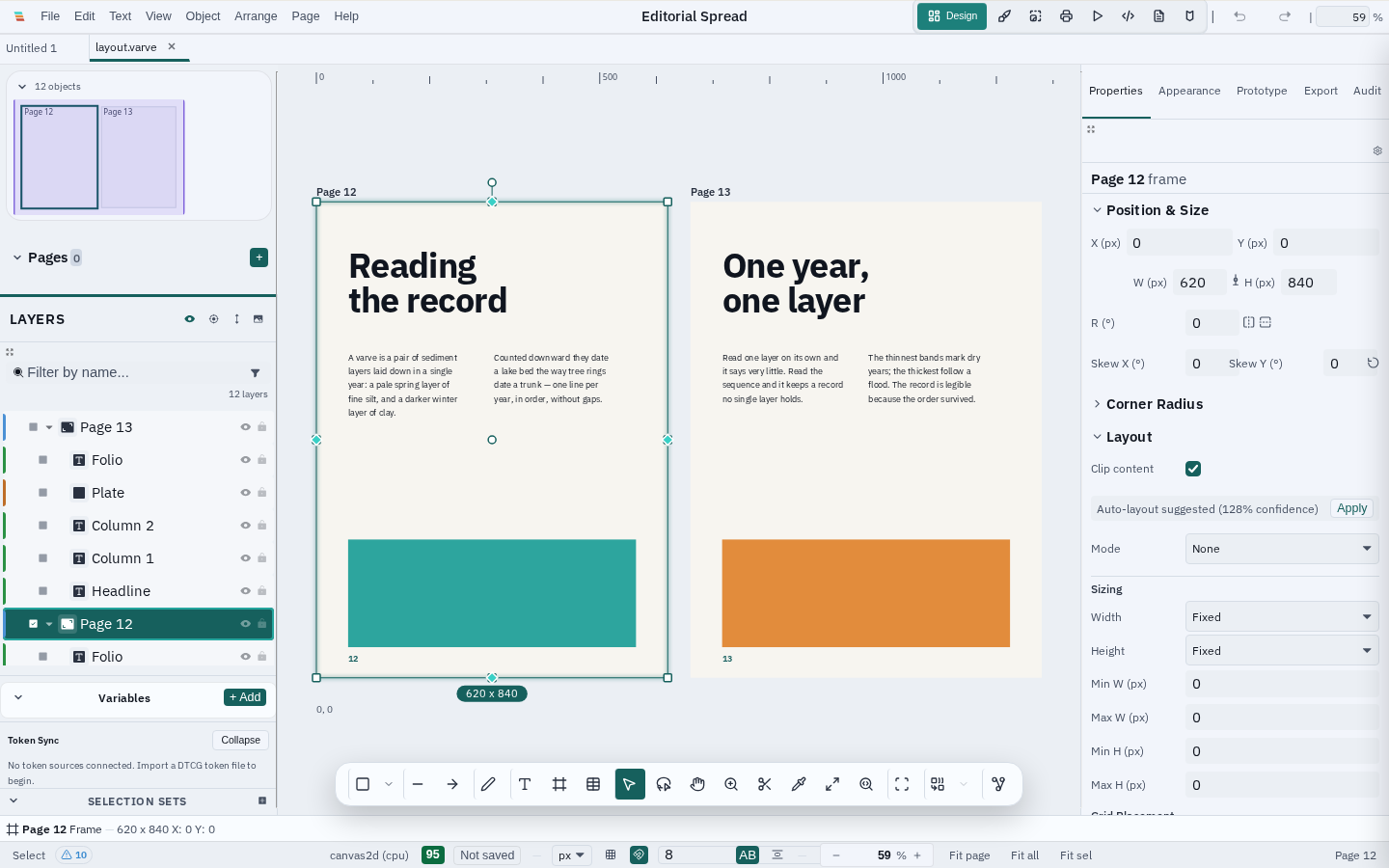
Key Capabilities
- Infinite canvas: Floating origin camera system for unlimited workspace
- Viewport culling: Only render what's visible for performance at scale
- Dirty-rect redraw: Minimize redraws to changed regions
- Precision tools: Sticky snap, numerical precision, sub-pixel accuracy
- Multi-page support: Work with multiple artboards/pages in one document
- Rulers and guides: Visual guides for alignment and measurement
- Grid overlays: Configurable grid patterns for precision work
Technical Depth
The rendering pipeline is built on IR-replay (ADR-0001), validated empirically on Wayland Linux. The engine uses viewport culling, dirty-rect redraw, and spatial indexing for fast hit testing. The SubtreeReplayCache optimizes repeated rendering of unchanged subtrees.
Current benchmarks show 86fps canvas2D replay with the IR-replay architecture. The same facade works on desktop (native Rust via Tauri IPC) and web (WASM) with zero functional compromise.
Limitations
Current limitations:
- Some legacy integrations still expose world-space values; use the artboard-local conversion helpers for page-aware tools and exports
- Collaboration features are UI scaffolding only (no transport or wire protocol)
Related Documentation
- Architecture Overview - IR-replay architecture details
- Rendering Pipeline - Canvas system internals
- Render Pipeline Documentation